Lower Blepharoplasty
Lower eyelid surgery at CFH, Istanbul. Trans-conjunctival or sub-ciliary approach chosen by your surgeon for your fat-pad anatomy. Same surgeon from intake to twelve-month review. JCI + TEMOS accredited facility.
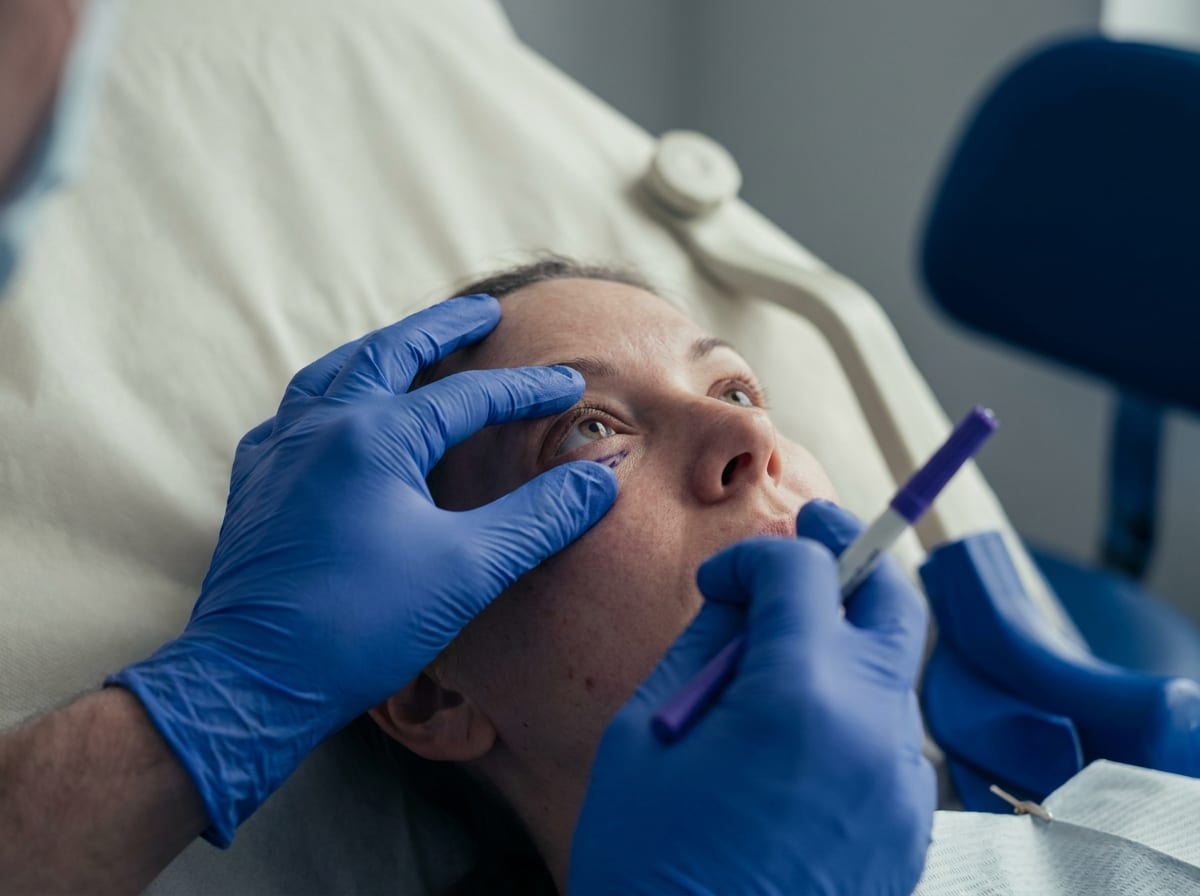
The lower eyelid holds a structural pocket of fat between the eye and the skin. When that fat pad shifts forward — or the surrounding tissue loses support — you get the persistent puffiness and shadow that no amount of sleep corrects. Lower blepharoplasty is the surgical procedure that addresses this directly: the fat is redistributed or removed, the supporting structures are tightened where needed, and the lower lid sits back in its natural plane.
It is one of the more precisely anatomy-dependent operations in facial surgery. The approach your surgeon uses — trans-conjunctival (incision inside the lower lid, leaving no external scar) or sub-ciliary (a fine incision just below the lash line) — depends entirely on the fat-pad configuration and the degree of skin laxity your individual anatomy presents. The two are not interchangeable; choosing the wrong one for a given patient produces a different result than the right one.
Who is a good candidate for lower eyelid surgery
Most patients presenting for lower blepharoplasty have one or more of the following:
- Persistent puffiness or bags under the eyes that are structural, not related to fluid retention or fatigue
- A shadowed or hollowed appearance caused by fat herniation casting a crease
- Fine wrinkling or creping of the lower lid skin (where skin removal is appropriate)
- An asymmetry between the two lower lids in terms of fat-pad volume or position
Lower blepharoplasty is not a substitute for managing general eye-area hollowing caused by overall volume loss — that is a different problem addressed differently. At consultation, the surgeon maps which part of what you see is structural (operable) and which is not, and plans accordingly.
Age range is wide. The procedure is performed from the late thirties onward when anatomy warrants it, with no upper ceiling if medical fitness allows.
How the surgery is performed at CFH
Lower blepharoplasty at CFH takes approximately 1.5 to 2 hours. Anaesthesia is local with sedation in the majority of cases; general anaesthesia is used when anatomy or patient preference calls for it. That decision is made before the day of surgery, not on the morning of it.
The trans-conjunctival approach leaves the incision entirely inside the lower lid — no visible scar, and the technique is well suited to patients whose primary concern is fat herniation with good skin quality. The sub-ciliary approach is used when skin redundancy needs to be addressed at the same time; the resulting scar sits in the natural shadow of the lash line and fades over the settling period.
Fat management is the operative question. Fat can be excised, redistributed into adjacent hollows, or a combination of both — depending on whether the lower lid has a hollow component that simple removal would worsen. The surgeon decides intraoperatively, working from the plan drawn from your pre-operative photographs.
Upper and lower blepharoplasty are frequently performed together when the clinical picture warrants it. That pairing is assessed at consultation and is part of the signed plan you receive before any commitment is made.
The week after lower blepharoplasty — what to expect
Visible bruising and swelling are most pronounced in the first three to four days. Most patients are comfortable at home — not distressed, but not presentable in a professional setting. By day seven the swelling has reduced substantially and the majority of patients are no longer self-conscious in public, though some residual pinkness around the lower lid may persist for a further week or two.
The six-month mark is when the result is fully settled. Lower lid oedema clears more slowly than it feels like it should — the lower eyelid is a low-drainage zone — and the first eight to ten weeks can involve fluctuating puffiness that has nothing to do with the final outcome. Your surgeon explains this at the pre-operative review and again at discharge so you are not reading changes in the wrong timeframe.
You will need to sleep with your head elevated for the first week. Activities that raise vascular pressure — exercise, alcohol, bending forward — are restricted for the same period. Flying home on day seven is standard for international patients.
What could be different from your expectation
Some patients arrive expecting lower blepharoplasty to remove dark circles. Pigmentation — whether constitutional or vascular — is not altered by the surgery. The shadow from a fat herniation improves when the fat pad is addressed; true pigmentation does not. The surgeon will tell you plainly at consultation which part of your presentation is operable and which is not.
Some patients have a hollowing component beneath the fat herniation. If this is present and not accounted for, simply removing fat makes the hollow worse. Managing the two together — redistribution, not excision — addresses both. This is the anatomical assessment your surgeon performs before signing the plan.
Settling is not linear. The lower lid swells, then improves, then may fluctuate with fluid intake and sleep position before it settles permanently. The twelve-month review is the close-out, not the three-month one.
The CFH surgeon-led model and why it matters here
Face surgery lives with a patient for years. The lower eyelid, specifically, is visible in nearly every social interaction — across a table, on a video call, in daylight. The consequence of a plan that did not account fully for the individual anatomy is also visible for years.
At CFH, the surgeon who conducts your intake assessment is the surgeon who signs the operative plan and performs the procedure. There is no transfer from a consulting surgeon to an operating team the patient has not met. The same surgeon reviews the lower lids at the post-operative check and at the twelve-month video review.
This is not a marketing preference — it is an operational commitment. The surgeon owns the case from the first call to close-out. If something needs explaining between scheduled reviews, the coordinator connects you with the same surgeon, not a general clinical response.
CFH operates from BHT Clinic in Istanbul, a JCI-accredited and TEMOS-certified facility that has been in continuous practice since 1994. Intake is conducted in eight languages — English, Romanian, Italian, Spanish, French, Albanian, Arabic, and Farsi.
The international patient journey for lower blepharoplasty
For patients travelling to Istanbul from abroad, the standard programme for lower blepharoplasty runs across five nights. Pre-operative bloods are drawn at the recovery hotel on arrival; there is no separate clinic shuttle on the day before surgery. The surgeon reviews you on the morning of the procedure.
On the day of surgery, the coordinator stays close. Post-operatively, recovery in Istanbul allows the most critical swelling phase to pass under the surgeon's watch. The first post-operative check — normally day two or three — is with the same surgeon.
By day seven, most patients fly home. Before leaving, the three-month and twelve-month video reviews are already scheduled. The coordinator remains reachable for the full twelve-month period.
The written plan — including the approach selected, the expected recovery arc, and the follow-up schedule — is provided in your language before any travel is booked. There is no fee for the plan and no obligation to proceed.
Frequently asked questions — lower blepharoplasty
What is the difference between lower blepharoplasty and an eye bag removal?
They are the same procedure described differently. "Eye bag removal" is the patient-facing term for what surgeons call lower blepharoplasty. Both refer to the surgical reduction or redistribution of the lower eyelid fat pads, with or without skin adjustment depending on anatomy.
Which approach — trans-conjunctival or sub-ciliary — is right for me?
This is determined by your anatomy, specifically the relationship between the fat herniation and your skin quality. If your skin has good tone and laxity is not a significant component, the trans-conjunctival approach leaves no external scar. If skin excess is present, the sub-ciliary incision addresses it. Your surgeon makes this assessment at the pre-operative review using your photographs; it is documented in the signed plan.
Can lower and upper blepharoplasty be done at the same time?
Yes, and it is common. Upper blepharoplasty (addressing hooded upper lids) and lower blepharoplasty are frequently performed in the same operating session when both are indicated. Whether to combine them is a clinical question your surgeon answers after reviewing both lids. The total operating time and recovery arc are adjusted accordingly.
How long does the result last?
Lower blepharoplasty addresses the structural fat herniation permanently — the fat repositioned or removed does not re-herniate in the same way. However, the eyelid continues to age normally. Most patients find the result holds for a decade or more before further changes from general ageing become relevant.
Will lower blepharoplasty remove my dark circles?
Not if the dark circles are pigment-based. Lower blepharoplasty improves the shadow cast by fat herniation — which many patients describe as dark circles — but true pigmentation beneath the eye is not altered by surgery. Your surgeon will identify at consultation which component of your lower lid appearance is structural (and therefore operable) and which is pigmentary.
What is the recovery timeline for travelling patients?
Most international patients plan five nights in Istanbul. Bruising and swelling are most visible in days one through four. By day seven the majority of patients are comfortable flying. The full settling period is six months; the twelve-month video review is the formal close-out of the case.
Is the consultation free?
Yes. Once you submit photographs and your history, your matched surgeon provides a written plan — approach, recovery arc, follow-up schedule — at no charge and with no obligation to proceed. The plan is provided in your language within 48 hours of the photographs being reviewed.
Begin a consultation
One surgeon, from the first conversation to the twelve-month review. Tell us what you are considering — we will tell you honestly what is possible.