Beard Restoration
Surgeon-led beard hair restoration at CFH Istanbul. FUE technique, local anaesthesia, natural direction placement. Same surgeon from consultation to your nine-month density review.
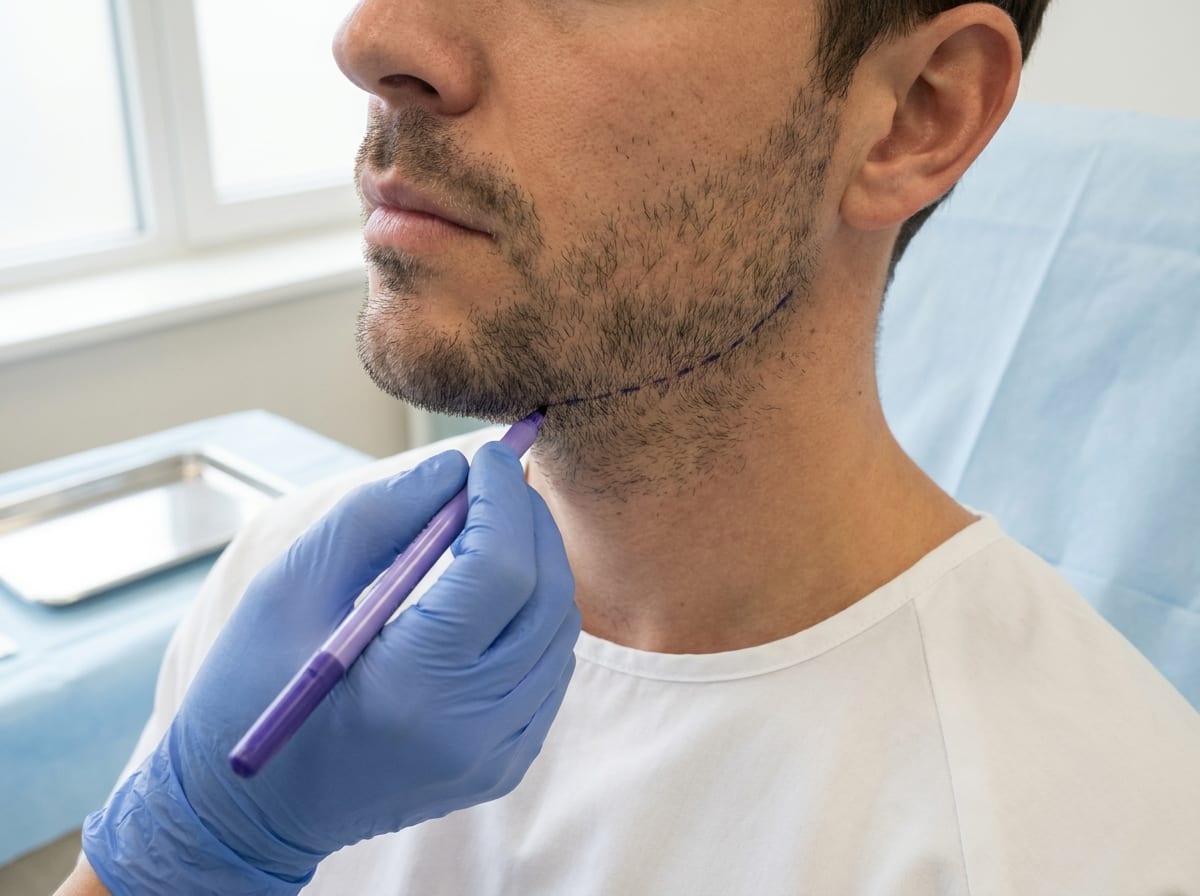
Beard transplant searches have climbed steadily across English-speaking markets, and the question behind them is almost always the same: can a patchy or absent beard be corrected permanently, and can it be done with a result that looks genuinely natural rather than obviously placed?
The short answer is yes — with the right surgical approach and the right planning session before any follicle is touched. This page covers how beard hair restoration works at CFH, who is a good candidate, what the procedure involves, what recovery looks like in plain language, and what to think about when you are comparing clinics.
What beard restoration at CFH actually involves
Beard hair restoration at CFH is a follicular unit extraction (FUE) procedure performed under local anaesthesia, typically running four to six hours depending on the area being addressed and the graft count required.
The procedure runs in two phases. In the extraction phase, individual follicular units are taken from the donor area — usually the suboccipital scalp, occasionally the neck — using a micro-punch. In the implantation phase, each follicle is placed into the recipient zone at a single, consistent axis that matches the natural growth direction of facial hair. That single-axis placement is the technical detail that separates a natural-looking result from one that looks worked on.
Beard restoration can address:
- Patchy beard coverage — gaps in the cheek beard, chin, or moustache zones
- Absent beard growth — including men who have never grown a full beard due to follicular absence rather than hormonal factors
- Scarring within the beard zone — trauma or surgical scars that have disrupted natural growth
- Beard density work — adding density to an existing beard that grows but lacks fullness
The procedure is standalone or can be combined with scalp hair work in the same session, depending on donor availability and the scope of the plan.
The planning session comes first
At CFH, no follicle is placed before the plan is drawn and signed. Your surgeon maps the recipient zone against your bone landmarks — the angle of the jaw, the position of the chin, the natural terminus of the sideburn — and agrees the density target with you before the procedure begins. The plan you receive in writing is the plan that gets executed. The surgeon who signs it is the surgeon who performs it.
Who is a good candidate for beard transplant?
Beard hair restoration works best when:
- The donor area (scalp) has sufficient density to provide grafts without visible thinning at the harvest site
- The reason for sparse or absent beard growth is follicular — not hormonal or autoimmune (alopecia areata affecting the beard zone requires a different assessment path)
- Expectations are calibrated to the biology: transplanted follicles grow in the same cycle as scalp hair and reach full density at around nine months, not nine weeks
A pre-procedure consultation assesses donor density, skin quality in the recipient zone, and whether any underlying condition should be investigated before surgery. This is not a formality — it is the step that determines whether the plan is realistic.
What could make the picture more complicated
Beard restoration is not the right path for everyone, and a good consultation surfaces this early:
- Active alopecia areata in the beard zone — transplanted follicles can be affected by the same autoimmune process; the dermatological picture needs to be stable first
- Insufficient donor density — if scalp donor supply is also needed for scalp work, the allocation between the two areas requires careful planning
- Unrealistic density targets in a very small zone — overcrowding follicles produces an unnatural result; the surgeon's job is to design within the biology, not around it
None of these are disqualifying in themselves — they are factors that change the plan or the sequencing. The consultation exists to answer them honestly.
Recovery: what to expect and when
Beard restoration recovery is different from scalp hair transplant recovery in one important way: the face is more visible than the scalp, and the first five days are the ones patients most want to plan around.
Days 1–3: Some swelling and redness in the recipient zone is expected. The grafts are fragile during this period — sleeping elevated, avoiding direct water pressure on the face, and following the washing protocol provided at discharge are the priorities.
Days 4–5: Redness begins to resolve. Most patients feel comfortable in public settings by day five, particularly with a few days of beard stubble growing around the treated zone.
Weeks 2–4: Transplanted hairs shed. This is expected and not a sign that the procedure has failed. The follicle remains in place; the hair shaft falls and the follicle enters a resting phase before the new growth cycle begins.
Months 3–5: Initial regrowth becomes visible. The hairs are often finer at this stage than they will be at full maturity.
Month 9: Density review. This is the point at which the final result can be properly assessed. CFH books this review as part of the original plan — it is not an afterthought.
The recovery hotel stay for beard restoration is typically three nights. Most patients fly home on day four or five.
Why the surgeon continuity matters in beard work
Beard transplant outcomes are highly sensitive to two decisions: the hairline design (or in this case, the beard boundary design) and the implantation axis. Both are surgical judgement calls that happen at the operating table, not in a planning document.
At CFH, the surgeon who drew the beard map at your consultation is the surgeon making those calls on procedure day. There is no delegation to a technician team for the implantation phase. The coordinator who managed your pre-operative paperwork is the same person you message if a question comes up at day three of recovery.
This is not a marketing point about luxury. It is a structural commitment that affects the quality of the result — because the surgeon who designed the plan knows why each decision was made, and can make real-time adjustments on procedure day that a technician following a diagram cannot.
What beard restoration at CFH costs
The procedure band for beard restoration at CFH is €2,200 – €3,600. That covers local anaesthesia, the procedure session, the recovery hotel, and the follow-up protocol through to the nine-month density review.
What matters is not just the procedure price but what the price includes: who performs the implantation, how the follow-up is structured, and what happens if a question arises six months after you have flown home.
The band above exists so you can assess whether the conversation is worth starting. An accurate quote for your specific case — graft count, combination scope — comes from the written plan your surgeon issues before any commitment is made.
The CFH process for international patients
Beard transplant patients arriving from outside Turkey follow the same structured pathway as all CFH international patients:
- Intake call — in your language (English, Romanian, Italian, Spanish, French, Albanian, Arabic, or Farsi). Your coordinator takes the brief; your surgeon reviews the photographs you upload.
- Written plan — your surgeon signs a written plan within 48 hours of receiving your photographs and history. No fee for this step; no obligation to proceed.
- Travel coordination — airport transfer, recovery hotel, and pre-operative bloods at the hotel (no clinic visit needed the day before).
- Procedure day — local anaesthesia, four to six hours, the named surgeon performs from extraction through implantation.
- Discharge — washing protocol, aftercare card in your language, and the nine-month review already booked before you leave Istanbul.
- Follow-up — video check-ins at month three and month nine with the same surgeon.
BHT Clinic, where CFH operates, holds JCI accreditation facility-wide and TEMOS certification for international patient care. Both are independently assessed by their respective accreditation bodies. The group has been in continuous practice since 1994.
Frequently asked questions about beard transplant
How many grafts does a beard transplant require?
This depends on the area being addressed and the density target. A targeted cheek-patch correction may require fewer grafts than a full beard construction from near-absence. The count is established during the planning session, not guessed in advance.
Will the transplanted beard hair look natural?
Natural appearance in beard transplant work depends on two things: the accuracy of the boundary design and the consistency of the implantation axis. Facial hair does not grow perpendicular to the skin — it grows at a shallow, specific angle that varies by zone. Placing grafts at the correct axis for each zone is the technical step that produces a result you cannot identify as transplanted.
Can I combine a beard transplant with scalp hair work?
Yes, when donor supply supports both. Combined cases run longer — typically eight to twelve hours — and require careful planning of donor allocation so neither area is compromised. Your surgeon assesses this in the planning session.
What is the right time of year to have the procedure?
Beard restoration can be performed year-round. Some patients prefer to plan around a period when they can wear a beard naturally during the early recovery phase — but the biological outcome is not affected by season.
Is a beard transplant permanent?
Transplanted follicles are taken from the permanent donor zone of the scalp and retain the growth characteristics of that zone. They do not shed with age in the way that genetically vulnerable scalp follicles do. The result is considered permanent.
What if I am not happy with the density at nine months?
The nine-month review exists precisely for this conversation. If density is below the target agreed at planning — for reasons within the biological range rather than from unrealistic expectations — your surgeon will discuss whether a second small session is appropriate. This is an honest conversation, not a sales call. It starts with the surgeon reviewing what was planned and what grew.