Otoplasty
Surgeon-led otoplasty (ear pinning) at CFH Istanbul. The same surgeon plans your procedure, performs it, and reviews recovery. JCI-accredited facility. Written plan in 48 hours.
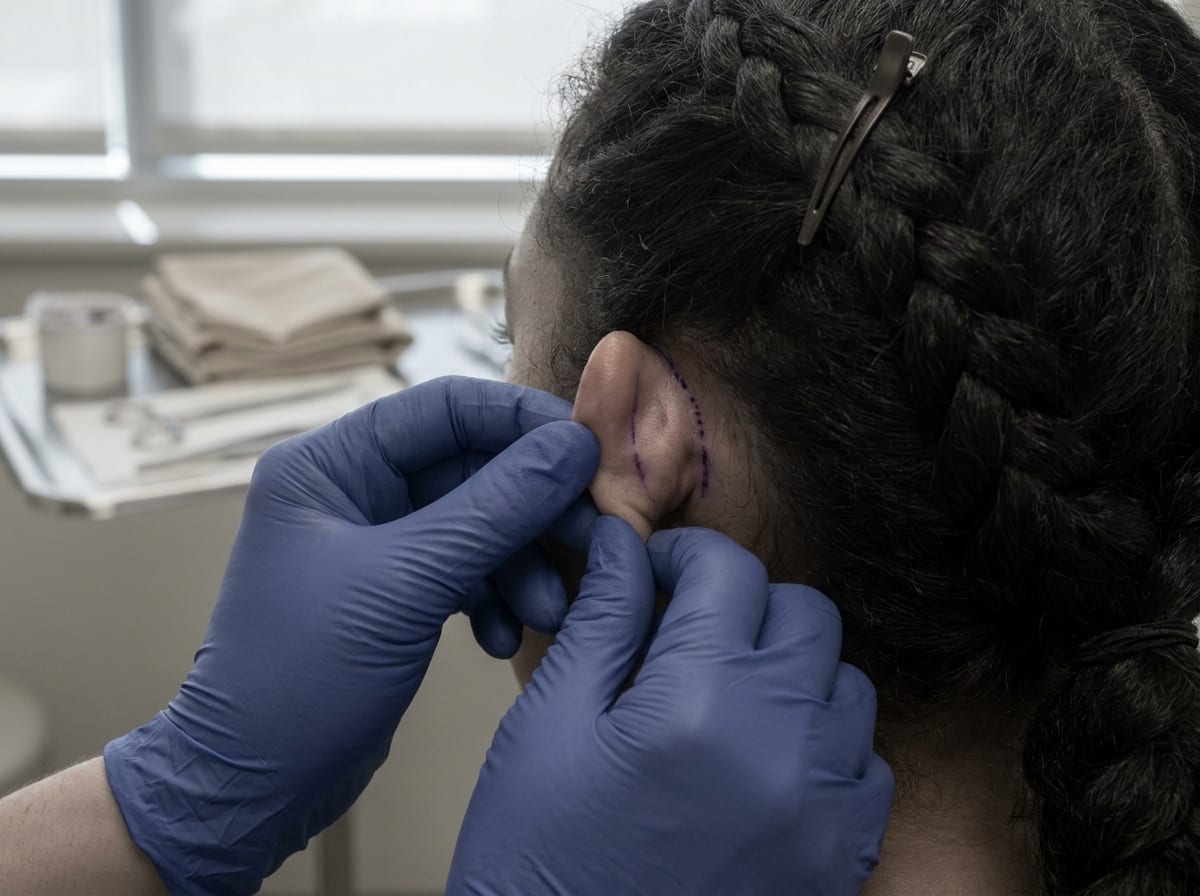
Most people searching for otoplasty in Turkey — or ear pinning, which is what many patients from the UK and Ireland call the same procedure — have already made a private decision. The ears have bothered them for years. They have read enough to know the surgery is straightforward. What they have not yet found is a clinic they can trust with the part that comes after the operating room.
At CFH, that is where the conversation starts. The surgeon who hears your intention on the first call is the surgeon who signs the plan, performs the procedure, and reviews your recovery at the six-month mark. Not a coordinator reading notes. The same person.
What otoplasty involves at CFH
Otoplasty — also called pinnaplasty or ear pinning — repositions ears that sit too far from the head, corrects an underdeveloped anti-helical fold, or reduces conchal excess. The two approaches we use are anti-helical fold reformation and conchal setback. Your surgeon chooses the technique — or combines them — based on the cartilage anatomy of your specific ear, not on a protocol applied uniformly across all patients.
The procedure runs between 90 minutes and two and a half hours, performed under local anaesthesia with sedation or general anaesthesia depending on what your surgeon recommends after reviewing your photographs and history. You remain at the recovery hotel for five nights, which is when the early healing matters most and when your coordinator is on call.
The planning stage
Before you travel, you receive a written surgical plan signed by your named surgeon. It covers the technique selected, the anaesthesia approach, and what recovery will look like for your case. There is no fee for the consultation or the plan, and no obligation to proceed.
This plan is what allows you to make a clear decision from home — not a brochure, not a quote from a form, but a document from the person who will be in the theatre.
Who is a candidate for otoplasty
Otoplasty is appropriate for adults and children from around the age of five or six, once ear cartilage has reached close to adult size. The most common presentations are:
- Ears that protrude significantly from the side of the head (prominent ears)
- An absent or underdeveloped anti-helical fold — the inner ridge of cartilage that normally creates the ear's natural contour
- Asymmetry between the two ears where one sits noticeably differently from the other
- A previous otoplasty that did not achieve the intended position or that has partially relapsed
The right candidacy decision is made with your surgeon, looking at photographs of your ear anatomy. General health and anaesthesia suitability are part of the pre-operative assessment.
Recovery: what the first weeks look like
Immediately after surgery, a soft bandage or headband holds the ears in their new position while the cartilage settles. You will wear this for roughly seven days — the period when the result is most visible to others around you.
What most patients describe as the hard part of recovery is actually the waiting rather than the discomfort. The ears look right within days. The final position settles over six months as any residual swelling resolves and the cartilage stabilises fully.
Days 1–7: Rest at the recovery hotel. Your coordinator checks in. If anything needs the surgeon's attention, that call happens.
Day 7: Dressing review with your surgeon before you fly home.
Month 3 and Month 6: Video reviews with your named surgeon. The six-month review is when the result can be assessed properly.
Practical notes for travelling patients
The five nights at the recovery hotel are not optional padding — they are when the critical post-operative window takes place. Your coordinator arranges airport transfer, the recovery hotel stay, and the pre-flight surgeon review before you return home. You do not need to organise these independently.
What could affect how your result settles
Otoplasty produces stable, long-lasting results in the large majority of cases. That said, honest planning requires acknowledging what can vary:
Cartilage memory — ear cartilage has a natural tendency to return toward its original position, particularly in younger patients with very elastic cartilage. The suture technique and the degree of cartilage scoring are calibrated to account for this, but a small degree of relapse can occur in some cases.
Asymmetry — because both ears are independent structures with their own cartilage anatomy, perfect symmetry is not guaranteed and is not the goal. The goal is harmony: ears that no longer read as prominent from a conversational distance.
Scar visibility — the incision sits behind the ear in the natural fold. In the early months it may feel firm or slightly raised. Over six to twelve months it typically fades and softens. Scar quality varies by individual skin type.
These are not reasons to avoid the procedure. They are the details your surgeon goes through with you at the planning stage so that you arrive at a clear, realistic picture of what to expect — not a promotional one.
Otoplasty at CFH: what the operational model means for you
The majority of patients who come to CFH for otoplasty travel from the UK, Ireland, and continental Europe. They are typically not looking for the lowest-cost option. They are looking for the surgeon they can trust to be accountable across the full arc — from the first photograph they submit to the six-month review they attend via video from home.
The CFH model is built for exactly that:
- One named surgeon who owns your case from intake to close-out
- JCI and TEMOS accreditation at BHT Clinic — the facility-wide international standards for hospital safety and international patient care
- Eight intake languages — English, Romanian, Italian, Spanish, French, Albanian, Arabic, and Farsi — so that nothing is lost between what you mean and what we plan
- Three decades of continuous practice under the Bahat Medical Group since 1994
- No consultation fee and a written surgical plan within 48 hours of submitting your photographs
The question of cost is a reasonable one. Otoplasty at CFH falls in the €3,400 – €5,200 range for the surgical procedure. What that figure includes — the named surgeon, the full recovery coordination, the post-operative review programme — is what the consultation stage makes clear.
Frequently asked questions
Is otoplasty painful?
Discomfort rather than pain is the more accurate description for most patients. The ears are tender in the first few days, and the bandage can feel tight. Painkilling medication is straightforward to manage this. Significant pain is not a normal feature of otoplasty recovery, and any unexpected level of discomfort is something your coordinator follows up with the surgeon promptly.
At what age can otoplasty be performed?
For children, most surgeons recommend waiting until the ear cartilage is close to adult size — typically around age five or six. There is no upper age limit. Adults commonly have otoplasty decades after first noticing the feature.
Will I need to shave my head?
No. The incision is made behind the ear in the natural skin fold. Hair does not need to be removed. Long hair can conceal the dressing comfortably during recovery.
How long before I can exercise after otoplasty?
Light walking is fine from the first days. Any activity that raises heart rate significantly — running, gym, contact sports — is typically deferred until after the two to three week mark, and activities with any risk of impact to the ears for longer. Your surgeon gives specific guidance at discharge based on your case.
Can I have both ears corrected at the same time?
Yes. Both ears are addressed in a single procedure. Operating on both in the same session is standard practice and allows the surgeon to compare and balance the two sides under the same conditions.
Will the result be permanent?
Otoplasty results are long-lasting. The repositioned cartilage remains in its new position in the great majority of cases. A very small proportion of patients experience partial relapse of one or both ears over time, most commonly in the first year. This is something your surgeon discusses with you at the planning stage and factors into technique selection.
Does CFH offer incisionless otoplasty?
Incisionless techniques — using sutures without a skin incision — are available for specific presentations. Whether this approach is appropriate for your anatomy is determined by your surgeon at the planning stage. Not every ear is suited to a suture-only approach, and your surgeon will not recommend a less robust technique simply because it sounds less invasive if your anatomy calls for something more reliable.
How does the process work if I am coming from the UK or Ireland?
The intake call happens in English, at a time that works for your schedule. You submit photographs the same day or the following day. Your named surgeon reviews them and signs a plan within 48 hours. From there, the coordinator handles travel logistics — visa invitation letter where needed, recovery hotel, airport transfer. You arrive, have the procedure, recover for five nights, attend the day-seven review with your surgeon, and fly home. Video reviews are booked before you leave the building.