Revision Hair Transplant
Surgeon-led revision hair transplant at CFH Istanbul. Correction of previous work planned and performed by one named hair surgeon, intake to twelve-month density review. JCI + TEMOS accredited.
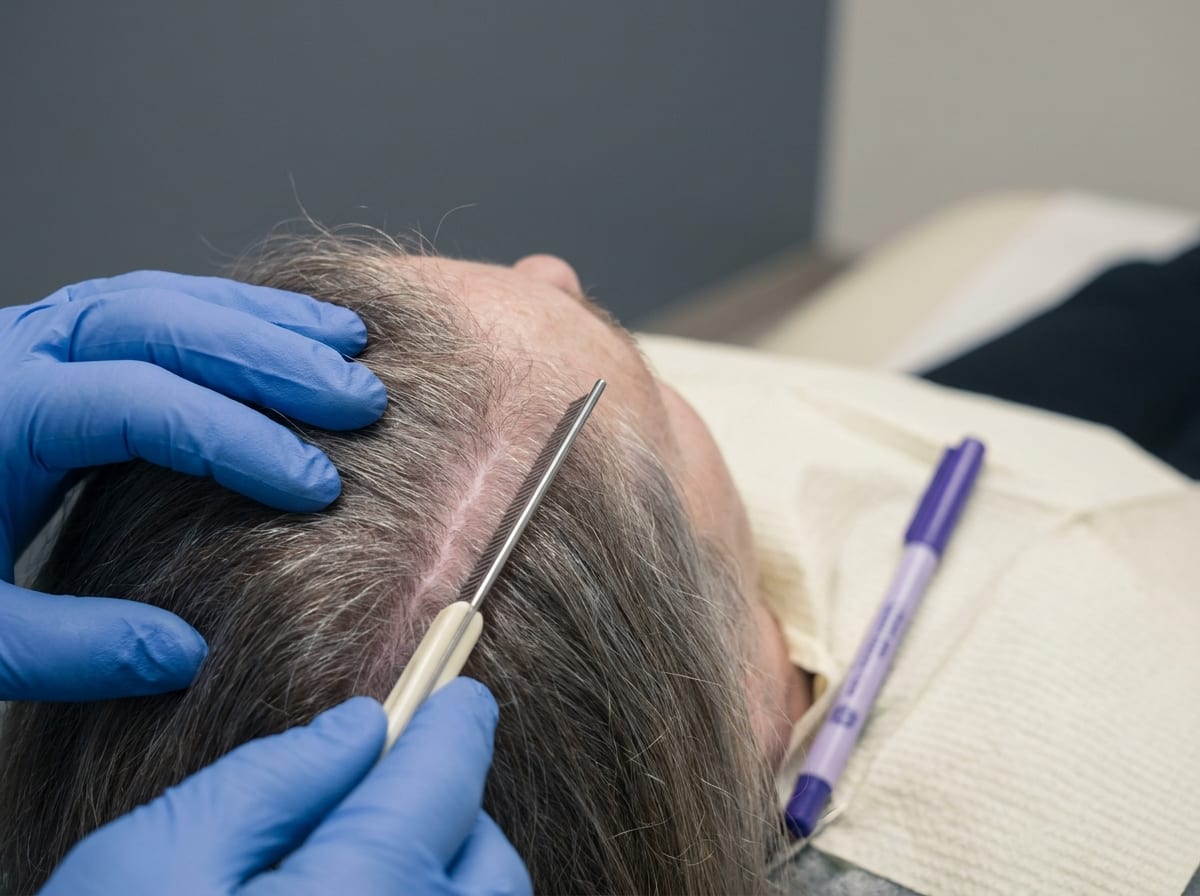
Not every hair transplant delivers what the patient was hoping for. A hairline drawn too low or too straight. Density that looked acceptable in early photographs but thinned badly by month twelve. Grafts placed at the wrong angle, so the hair grows away from the scalp rather than lying flat. Donor areas harvested too aggressively, leaving visible scarring or depleted zones. These are not rare outcomes — they are the most common reasons patients come to CFH for a second procedure.
Revision hair transplantation is technically more demanding than a primary case. The anatomy has already been altered. Existing grafts must be worked around. The donor supply — whatever was not used in the first procedure — has to be assessed carefully before any plan is committed to. These are not reasons to avoid revision; they are reasons to be precise about who plans it and who performs it.
At CFH, revision work is a significant part of the hair practice. The surgeon who assesses your previous result is the same surgeon who operates, who marks the recipient zone, and who reviews your density at three, six, and twelve months. That continuity is the only model we operate.
What a revision hair transplant involves
Revision cases at CFH begin with a detailed assessment of the previous work — what was done, what technique was used, how the grafts have settled, and what the donor area looks like now. This assessment drives everything that follows. There is no standard revision protocol because no two prior procedures leave the same anatomy.
The operative approach depends on what the assessment finds:
Density correction adds grafts into areas where coverage is inadequate. This is only possible if sufficient donor supply remains. The surgeon maps the donor zone carefully before committing to a graft count, because overharvesting the donor in a revision case can create a second problem while solving the first.
Hairline redesign addresses hairlines that are geometrically incorrect — too straight, too low, too aggressive, or mismatched to the patient's facial structure and age trajectory. In some cases this means adding grafts to soften an artificial edge; in others it means working with existing grafts and supplementing where natural growth patterns have not established.
Angle and direction correction is among the most technically involved forms of revision. Grafts placed at the wrong angle produce hair that stands away from the scalp rather than lying in a natural flow pattern. Correcting this requires either placing new grafts between existing ones to redirect the visual flow, or — in specific circumstances — removing and re-placing misaligned grafts, which carries its own constraints and risks the surgeon will explain at the planning stage.
Donor scar management is sometimes part of a revision plan when the previous procedure — particularly older punch techniques or strip harvesting — left visible scarring. Follicular unit extraction around the scar can reduce its visibility; the approach and realistic expectations are discussed before any plan is agreed.
Procedure duration at CFH for revision cases runs 8 to 14 hours depending on what the correction requires. Anaesthesia is local with sedation. Five recovery hotel nights are included in the plan.
Who is a good candidate for revision
Revision hair transplantation is appropriate when there is a clear, correctable problem with a previous result and sufficient donor supply to address it. Candidates typically fall into one of these situations:
- An unnatural hairline — too straight, too low, or too geometrically regular — that was apparent as soon as the initial result settled
- Inadequate density in the transplanted zone, where graft survival was poor or the original graft count was too low for the area covered
- An asymmetric result where one side grew differently from the other
- Hair growing in the wrong direction, producing an unnatural lying pattern
- A depleted or visibly scarred donor area from aggressive prior harvesting
- A technically sound first transplant that produced good initial density, but ongoing natural hair loss has since exposed the transplanted area and requires supplementary work
Not every patient who is unhappy with a previous result is a revision candidate immediately. Some results that look poor at six months are still settling at twelve. The surgeon will be direct about whether waiting is the right call, and about what revision can and cannot achieve given your specific donor reserve and anatomy.
Recovery in plain terms
Revision cases follow a similar recovery arc to primary transplants, with one important difference: the existing scalp has already been through one procedure, which can affect how the tissue responds and how quickly swelling resolves. The surgeon sets realistic expectations at the planning stage based on what your scalp looks like before the revision begins.
Typically:
- Days one to three: swelling and tightness in the scalp, most pronounced around the hairline and donor area. Head elevation, prescribed aftercare, and rest are the priorities.
- Days four to ten: the transplanted grafts begin to shed their initial hair shafts — this is expected and does not indicate graft failure. The follicles remain in the scalp and begin producing new growth from around month three.
- Month one to three: the scalp looks similar to how it looked before the revision as the grafts rest in their dormant phase. This period requires patience.
- Month four to eight: new growth becomes visible. Coverage and density build progressively.
- Month twelve: the density review with your surgeon. This is when the final outcome is assessed and documented.
Operative details at CFH:
- Duration: 8–14 hours
- Anaesthesia: local with sedation
- Recovery hotel: 5 nights
- Visible recovery: approximately 10 days
- Full density settle: 12 months
- Price band: €3,400 – €5,600
What could be different from what you expect
Revision hair transplantation has limits that primary cases do not. The most significant is donor supply. The follicles available for transplantation are finite — once a follicle has been harvested and placed, it cannot be used again. If the previous procedure used a large portion of your donor reserve, the options available for revision are correspondingly narrower. The surgeon will tell you this directly at the assessment stage, and will not plan a revision that over-commits your remaining supply to fix one problem while creating another.
The second constraint is graft survival in previously operated tissue. Scalp that has already received grafts can be less receptive to new follicles placed in the same area. Experienced revision surgeons account for this in their planning — spacing, depth, and angle choices are different from a primary case — but it remains a reason why revision density outcomes can be more variable than outcomes in untouched scalp.
For patients with unrealistic expectations about what revision can achieve — either because of severe donor depletion from a previous procedure or because the underlying hair loss pattern has continued to advance — the surgeon will be clear about the gap between what is wanted and what is anatomically achievable. That conversation happens before anything is agreed, not after.
How CFH plans a revision
The intake for a revision case is a 30-minute call in your language. You describe what the previous procedure involved, when it was done, and what concerns you about the result. No assumptions are made about what you need until your photographs have been reviewed.
Within 48 hours, the matched surgeon signs a written plan. For revision cases, this plan is more detailed than for primary cases — it specifies which aspects of the previous result are being addressed, what the approach is, what the donor supply assessment shows, and what the realistic range of outcomes is. That plan is yours to read, question, and take a second opinion on. There is no fee for this stage and no obligation to proceed.
On procedure day, the surgeon you spoke to is the surgeon marking the hairline and performing the extraction and implantation. The coordinator who managed your travel is in the building. Post-operative care follows a defined protocol — structured reviews at three, six, and twelve months — not a discharge sheet handed to you at the door.
CFH has been in continuous practice since 1994. The facility — BHT Clinic, Istanbul — holds JCI accreditation facility-wide and TEMOS certification for international patient care. Intake is available in eight languages: English, Romanian, Italian, Spanish, French, Albanian, Arabic, and Farsi.
Frequently asked questions
Can any hair transplant clinic do revision work?
Technically, yes — but revision cases require a different level of planning than primary cases. The surgeon needs to accurately assess residual donor supply, understand what technique the previous clinic used, and plan around existing grafts without damaging them. At CFH, the revision plan is built by the same surgeon who will perform the procedure, starting from a detailed assessment of your specific anatomy and previous result. The planning stage is not a formality.
How soon after my first transplant can I have a revision?
Generally, at least twelve months after the previous procedure. The transplanted grafts need to have fully settled before the outcome can be accurately assessed, and operating on immature grafts risks disrupting ones that might still produce good growth. For patients who have not yet reached twelve months post-procedure, the surgeon will typically recommend waiting and conducting a proper assessment once the result has stabilised.
I had a hair transplant in Turkey that I am unhappy with — is revision more difficult?
Not inherently. The country where the previous procedure was performed matters less than what was done, how it was done, and what the current state of your scalp and donor area looks like. The surgeon assesses the anatomy, not the provenance. What matters is the quantity and quality of donor supply remaining, the extent of the correction needed, and the condition of the recipient zone.
How many grafts are typically needed for a revision?
This depends entirely on what the assessment finds. Some revision cases require only a few hundred grafts to address a specific problem — an artificial hairline edge, a small area of poor density — while others require multi-session approaches where donor supply is carefully managed across more than one procedure. The surgeon will not commit to a graft count until the assessment is complete, because doing so before seeing your donor zone would be guesswork.
Will a revision fix the direction of hair that is growing the wrong way?
In many cases, yes — partially or substantially. New grafts placed at the correct angle, positioned between existing incorrectly-angled grafts, can redirect the visual flow of the hair as it grows. In some cases, the existing grafts create constraints that limit how much the direction can be corrected. The surgeon will give you an honest picture of what is achievable for your specific pattern at the planning stage.
What is the cost of a revision hair transplant at CFH in Istanbul?
The price band at CFH is €3,400 – €5,600, which includes the procedure, anaesthesia, the recovery hotel nights, and the twelve-month review schedule. The written plan you receive before committing specifies exactly what is included. There is no consultation fee.
Will I see the same surgeon throughout?
Yes. The surgeon who assesses your previous result is the surgeon who performs the revision, who conducts the wound review, and who carries out the density reviews at three, six, and twelve months. This is the only model CFH operates. There is no handover to a junior at any stage.
Do I need to speak Turkish to be treated at CFH?
No. Intake, planning, and all post-operative communication are available in eight languages: English, Romanian, Italian, Spanish, French, Albanian, Arabic, and Farsi. The written plan, after-care instructions, and close-out note are provided in your language.
Begin a consultation
One surgeon, from the first conversation to the twelve-month review. Tell us what you are considering — we will tell you honestly what is possible.